Why Grind Quality Outweighs Everything Else
Coffee extraction is controlled chemistry. Water at the right temperature dissolves soluble compounds from ground coffee in a predictable sequence: first acids and brightness, then sugars and body, then bitter and phenolic compounds at the end. The grinder determines whether that extraction process works as intended or collapses into chaos — because particle size uniformity is the single largest variable in extraction predictability.
A blade grinder fragments beans with a spinning blade, producing a cloud of dust and large chunks simultaneously. When that mixed-particle mass hits hot water, the dust over-extracts in seconds while the large chunks under-extract over minutes. Both effects are present in the same cup. The result: bitterness, sourness, and astringency competing with each other — not balance.
A burr grinder crushes beans between two abrasive surfaces set at a fixed distance, producing particles within a narrow, controllable size range. With uniform particles, extraction is predictable and adjustable. This is why the grinder is the gating investment in any serious home setup.
Conical vs. Flat Burr Grinders
The two burr geometries dominate the market and behave differently enough to understand before buying:
Conical burr grinders use a cone-shaped inner burr rotating inside a ring-shaped outer burr. The geometry is forgiving — beans feed by gravity, the narrow gap creates a mix of coarser and finer particles (bimodal distribution), and the design runs at lower RPM with less heat generation and static. Many home grinders in the $80–400 range use conical burrs.
Flat burr grinders use two parallel rings with cutting edges. Beans pass radially outward, producing a tighter, more unimodal particle distribution. Flat burrs run faster, generate more heat, and produce more static — but the output's particle uniformity is prized for espresso, where extremely fine adjustments matter. Commercial espresso grinders and high-end home units ($300–1,000+) typically use flat burrs.
For home use focused on filter methods (French press, pour-over, drip), conical burrs perform excellently and at lower cost. For espresso, flat burrs offer a precision ceiling that serious enthusiasts are willing to pay for. Most home setups benefit from a quality conical burr grinder rather than an entry-level flat burr.
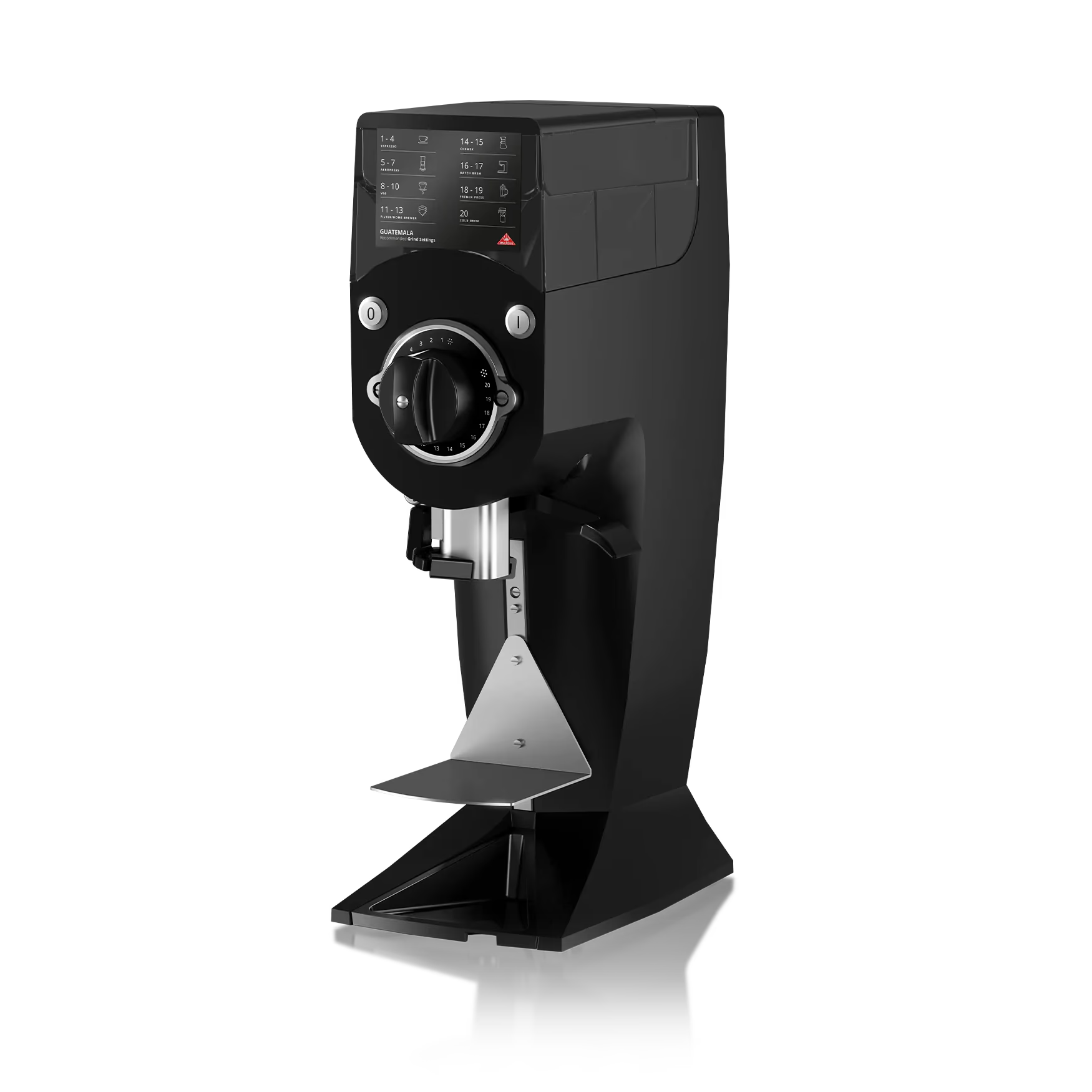
Grind Settings by Brew Method
| Brew Method | Grind Size | Particle Texture Reference | Typical Setting Range |
|---|---|---|---|
| Cold brew | Extra coarse | Rough breadcrumbs | 8–10 on most grinders |
| French press | Coarse | Sea salt / cracked pepper | 6–8 |
| Chemex | Medium-coarse | Coarse sand | 5–7 |
| Flat-bed drip (Kalita) | Medium | Beach sand | 4–6 |
| Hario V60 pour-over | Medium-fine | Table salt | 3–5 |
| Aeropress | Medium (variable) | Table salt | 3–5 |
| Stovetop Moka pot | Fine | Fine sand | 2–3 |
| Espresso | Fine–extra fine | Powdered sugar | 1–3 |
These ranges assume a stepped grinder where 1 is finest. Stepless grinders require calibration against your specific burr set and brewing device.
Top Grinder Picks by Category
Best Overall: Baratza Virtuoso+
The Virtuoso+ is the most recommended home conical burr grinder in the $150–200 range, and for good reason. Forty 40mm commercial-grade conical burrs cover the full grind range from espresso to French press with above-average consistency at each setting. The built-in digital timer allows dosing to 0.1-second precision — a feature usually found on grinders costing twice as much.
What sets it apart from cheaper options is Baratza's approach to repairability. The company sells individual replacement parts, publishes repair documentation, and maintains a phone support line. A Virtuoso+ bought today is likely to be serviceable in ten years. That longevity changes the cost calculus considerably.
The main complaint — grounds static, particularly in dry climates — can be mitigated with the Ross Droplet Technique: add one or two drops of water to the beans before loading. The improvement is substantial and costs nothing.
Best Budget: Baratza Encore (or OXO Brew Conical Burr)
The Baratza Encore uses the same 40mm conical burrs as the Virtuoso+ in a simplified body without the digital timer. It produces identical grind quality — only the dosing convenience differs. At street price around $150 (or frequently on sale), it's the clearest upgrade path from any blade grinder for filter coffee.
The OXO Brew Conical Burr Grinder competes in the same range with 38 effective settings (15 main steps with micro-adjustments between each), a generously-sized hopper, and a grounds container designed to reduce static. It performs well for drip, French press, and pour-over; espresso users will find it insufficient.
Best High-End: Option-O Lagom P100 (or Weber Key)
For the dedicated espresso practitioner, high-end flat burr grinders from manufacturers like Option-O (Lagom P100) and Weber (Key) represent the current ceiling of home grinding technology. These units use 83–98mm flat burrs, stepless adjustment systems with sub-micron resolution, and precision-machined housings that maintain burr alignment within tolerances measured in microns.
The Lagom P100 uses 98mm nitrogen-steel flat burrs and a magnetic alignment system that eliminates the wobble causing particle-size variation in cheaper flat burr designs. The result is an extremely even grind across espresso and filter settings, low retention, and minimal fines. Single-dosing (loading exactly the beans you need per brew) is the designed workflow.
These grinders run $500–1,000. They are investments for enthusiasts who have already optimized every other variable in their espresso setup and need the grinder to stop being the limiting factor.
Best Portable Manual: 1Zpresso J-Max
Manual grinders have advanced significantly. The 1Zpresso J-Max uses 48mm stainless steel conical burrs in an aluminum-alloy body, with an external adjustment dial calibrated in 8.8-micron increments — finer than most electric grinders in its price range. It produces grind quality competitive with electric grinders at two to three times the price.
The J-Max is single-dose by design (capacity around 35–40g). It requires physical effort — roughly 30–40 seconds of cranking per 15g espresso dose — but the resulting grind is excellent. For travel, camping, or office use where outlet access is limited, the J-Max is the clearest choice in the $150–180 range.
Other well-regarded manual options: Timemore Chestnut C2/C3 (budget; excellent for filter), Comandante C40 (precision-focused, used by competition baristas), Kinu M47 (heavy but extraordinarily consistent for espresso).
Best for Espresso at Value: Eureka Mignon Silenzio
The Eureka Mignon line offers flat burr performance for espresso at $200–250, significantly below the Lagom/Weber tier. The Silenzio model uses 50mm flat burrs and is engineered specifically for low noise and low retention. Grind consistency for espresso is better than any conical burr in its price range, though it won't match the precision of the $600+ tier.
The Mignon Silenzio is the recommendation for someone who brews espresso daily and wants to upgrade from a conical burr entry-level grinder without moving to the high-end tier.
Grind Freshness: Why Buying Pre-Ground Negates a Good Grinder
Coffee stales aggressively after grinding. Ground coffee exposes a vastly larger surface area to oxygen than whole beans — the same compounds that give fresh coffee its brightness and aroma oxidize in minutes. The standard recommendation in specialty coffee is to grind immediately before brewing, within a minute of brewing if possible.
The practical implication: a $50 burr grinder used to grind fresh beans immediately before brewing will produce a better cup than $100 specialty beans bought pre-ground and stored for two weeks. Freshness and grind timing matter more than equipment cost at the budget end of the quality spectrum.
Grinder Maintenance: What Actually Matters
Most home grinders fail from neglect, not use. The critical maintenance tasks:
Weekly cleaning: Remove the upper burr (follow your specific model's instructions) and brush out coffee oils and residue from both burrs and the grinding chamber. Coffee oils oxidize and turn rancid, imparting a flat, stale character to all subsequent grinds. A dedicated cleaning brush takes two minutes.
Monthly deep cleaning: Use commercial grinder cleaning tablets (Urnex Grindz are the industry standard) to absorb oils in areas the brush can't reach. Run a full dose through, then run a small amount of your normal beans to clear any tablet residue before brewing.
Avoid oily beans in grinders not designed for them: Dark-roasted, oily beans (shiny surface) clog fine grinding mechanisms and coat burrs quickly. Most home grinders handle them fine for coarse/medium settings but struggle at fine/espresso settings. Check your grinder manufacturer's guidance.
Replace burrs on schedule: Ceramic burrs last longer; steel burrs need replacement every 500–1,000 kg of coffee depending on hardness. A dramatic decline in grind consistency is the signal. Replacement burr sets are available from Baratza, Eureka, and most quality manufacturers.
Frequently Asked Questions
Is a burr grinder worth the investment over a blade grinder?
Yes, definitively. Blade grinders produce inconsistent particle sizes that cause simultaneous over- and under-extraction in the same cup — a problem no other adjustment can fix. Even an entry-level burr grinder ($40–60) produces meaningfully more consistent results. For filter coffee, a $150 burr grinder represents the largest single quality improvement per dollar in a home setup.
How many grind settings do I actually need?
For a single brew method (French press only, or pour-over only), 10–15 settings covering that range is sufficient. For multiple methods including espresso, you want at least 30 distinct settings with micro-adjustment capability, or a stepless system. Stepped grinders with fewer settings may leave gaps in the espresso dial-in range.
What is single-dosing and why do some grinders support it better?
Single-dosing means loading exactly the beans needed per brew session rather than keeping beans in the hopper. This preserves bean freshness (sealed container vs. open hopper) and allows easy switching between origins. Grinders designed for single-dosing have minimal retention (residual coffee in the mechanism) — ideally under 0.5g. The Niche Zero, Weber Key, and Lagom P100 are all optimized for single-dose workflows.
Can I use any burr grinder for espresso?
Not all burr grinders can produce the fine, consistent particle size espresso requires. Look for grinders with a dedicated espresso range (fine end of the adjustment), low retention to keep dial-in waste minimal, and enough adjustment resolution to make incremental changes between shots. Entry-level burr grinders like the Baratza Encore can produce espresso-range grinds but lack the precision for consistent shot-to-shot dialing.
Conclusion
The grinder is the highest-leverage component in any home coffee setup — more impactful than the brewing device, more impactful than the water temperature, and in most cases more impactful than the coffee itself at the specialty tier. A Baratza Virtuoso+ paired with freshly roasted whole beans and a $25 French press will consistently outperform a $300 espresso machine paired with a blade grinder and pre-ground commodity coffee. Invest in the grinder first, then optimize everything around it. Browse our coffee beans selection for freshly roasted specialty coffees — single-origins and blends optimized for both filter and espresso extraction.