What separates an espresso grinder from a coffee grinder
Espresso works a grinder harder than any other brew method. The coffee bed resists water at high pressure, so a particle distribution that drifts a little becomes a shot that runs fast or chokes. Three attributes matter more than brand names:
- A grind range that includes espresso. Filter-first grinders often stop short of espresso fineness. Every pick below either lists espresso in its suitable-for range or is espresso-only by design.
- Fine, stable adjustment. Espresso sits in a narrow window of the dial, so the adjustment needs to move in small steps and hold its position through a session. The general burr-type and grinder-architecture background lives in our coffee grinder buying guide; this page stays on what espresso adds on top of it.
- Retention and dose control. Grounds left in the chute end up in tomorrow's shot, and timed dosing drifts as the hopper empties. Single-dose bellows, doserless on-demand grinding, and grind-by-weight are the three ways the picks below handle it.
Burr shape matters too, though less than these three. Flat burrs (two parallel rings) and conical burrs (a tapered cone inside a serrated ring) both grind fine enough for espresso; flat burrs run at higher RPM and produce a tighter particle distribution at very fine settings, while conical burrs run cooler and quieter. Blade grinders, which chop rather than crush, cannot hold a consistent particle size at any setting and are not suitable for espresso at all; every pick on this page is a burr grinder.
Grind precision: why adjustment matters more at espresso fineness
Check the adjustment first. Dialing in espresso works in small increments: you move the setting finer until the shot slows, then back off one step. A grinder that jumps between coarse positions turns that process into guesswork, which is why every pick in this guide adjusts steplessly.
Range matters too. A dedicated espresso grinder narrows the scale to what a portafilter needs, which makes each adjustment step smaller and repeatable. An all-round grinder trades some of that resolution for the ability to swing from Turkish fineness to French press coarseness, which is the right trade only if you actually brew both. For how grind fineness maps to extraction, see our espresso grind size guide.
- the espresso window
Dose consistency: single dose, hopper, and grind-by-weight
Three dosing models dominate, and the price ladder mostly follows them:
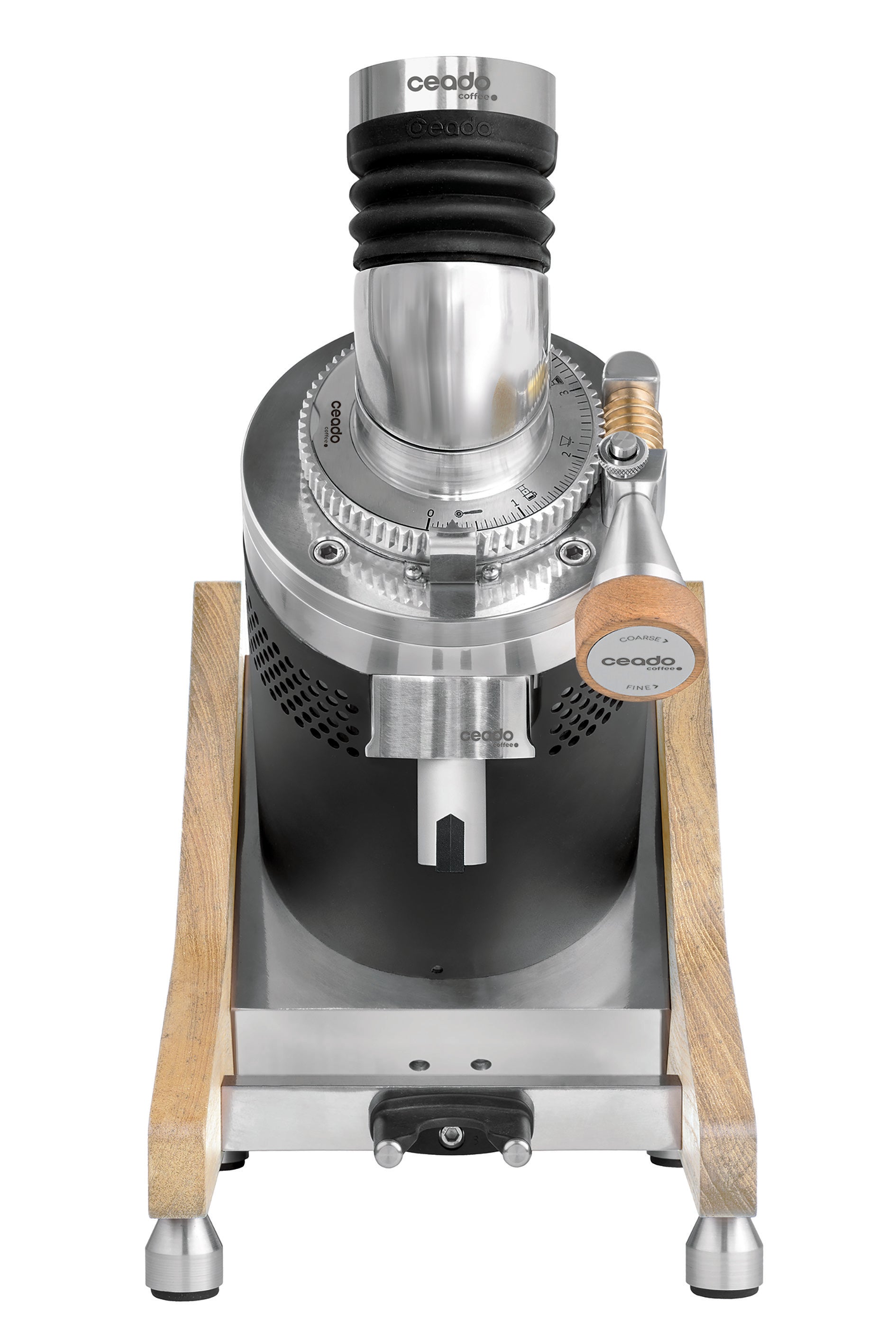
- Single dose. You weigh beans per shot and grind them all. A bellows or sweep system ejects what would otherwise stay in the chute, so each dose is fresh and no origin bleeds into the next. The Ceado Life brings this to home counters; the Ceado E37Z Naked brings it to cafe counters.
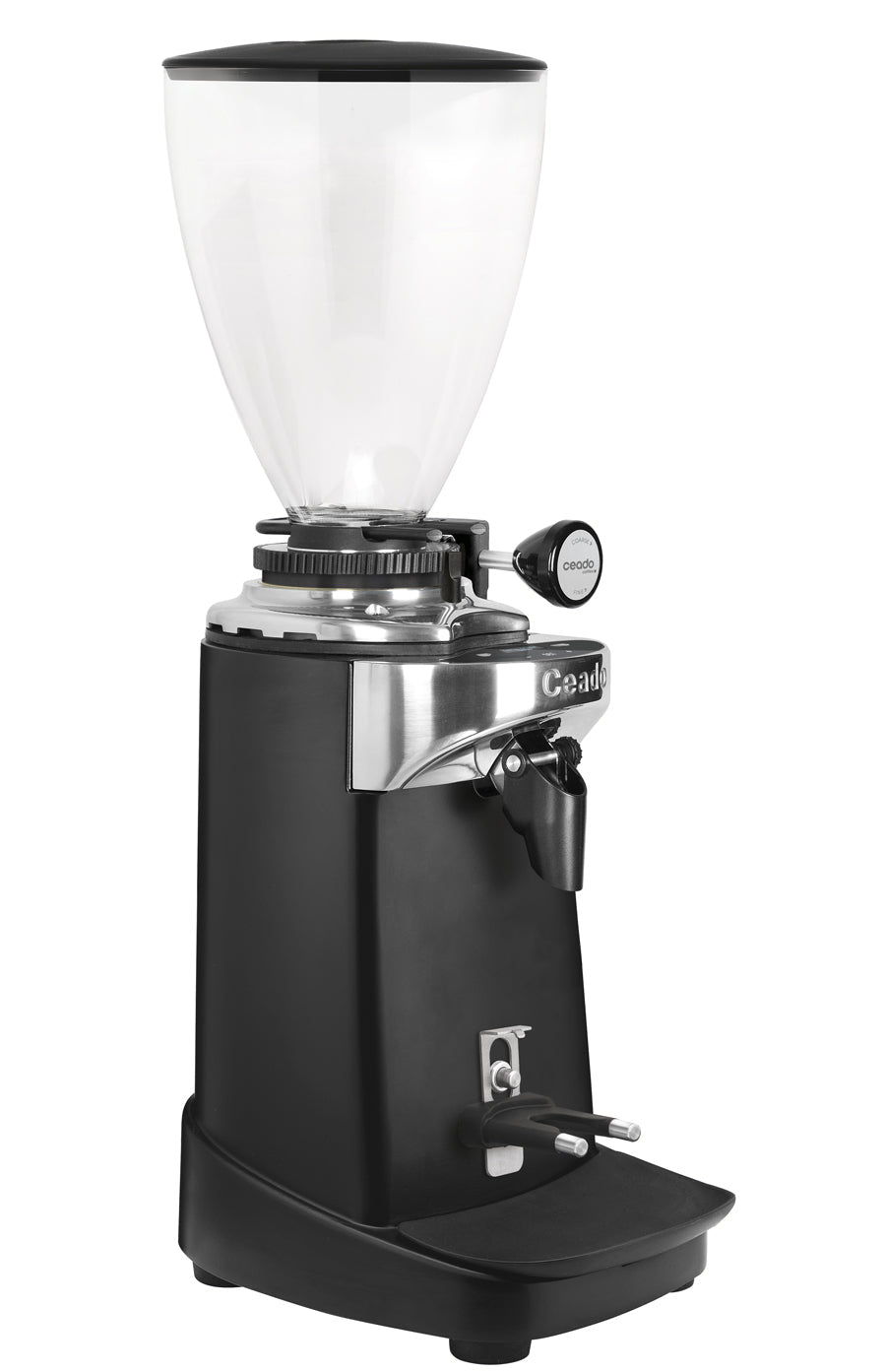
- Doserless on-demand. A hopper feeds the burrs, and the grinder doses straight into the portafilter on demand. This is the standard cafe workflow, and it is how the E65S and E80S are built.
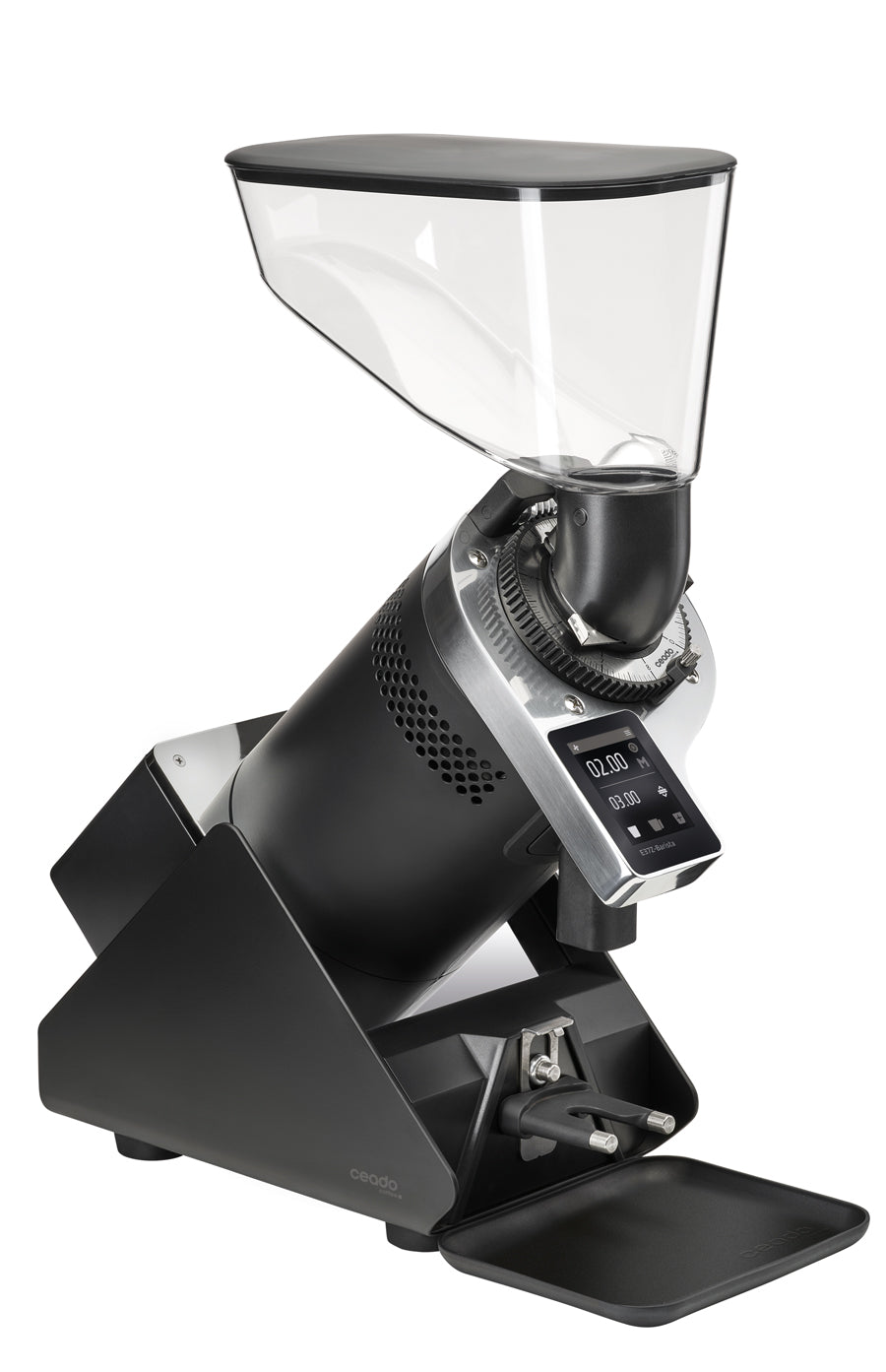
- Grind-by-weight. The grinder weighs the dose in real time on a load cell under the portafilter and stops at the target weight, which removes the dose variance that comes with timed grinding.
- the dose path
Burr size and duty cycle: matching the grinder to your volume
Burr diameter is a throughput spec. A 54 mm flat set grinds a few shots a day without complaint; a cafe pulling 200 shots needs larger flat burrs and a motor with active temperature control so the grind profile holds from the first shot to the last. That is the real difference between the home picks and the E65S, not shot quality in isolation.
- daily volume
It is also why a cafe should not buy two small grinders instead of one big one. Two 54 mm machines cost more to maintain and still lose to a single 65 mm or 80 mm flat-burr platform under peak load.
Best espresso grinders at a glance
| If you are | What to look for | Our pick | From |
|---|---|---|---|
| Home, espresso plus filter coffee | Full grind range, stepless adjustment, quiet motor | Mahlkönig X54 | $599 |
| Home, espresso only | Espresso-only range, single-dose bellows | Ceado Life | $499 |
| Small cafe | 65 mm flat burrs, doserless on-demand workflow | Mahlkönig E65S | $2,199 |
| Cafe, milk-heavy or high volume | Grind-by-weight dosing, 80 mm flat burrs | Mahlkönig E80S GbW | $3,699 |
| Single-dose purist, any scale | Near-zero retention, 83 mm flat burrs | Ceado E37Z Naked | $4,500 |
Our picks
Mahlkönig X54. The home all-rounder: 54 mm flat burrs, stepless adjustment across espresso to French press, a grind sound below 70 dB(A), and a doserless design, from $599. (Mahlkönig documents 54 mm special steel flat burrs for the X54.) Choose it if you brew espresso and filter coffee from one machine and do not want two grinders.
Ceado Life. The dedicated home espresso pick: an espresso-only grind range, handmade in Venice, with dual-mode operation that runs as an on-demand hopper grinder or switches to single-dose bellows mode, from $499. The zero-retention bellows ejects virtually all grounds, so each dose is fresh and uncontaminated.
Mahlkönig E65S. The small-cafe workhorse: 65 mm flat steel burrs, an espresso-only grind range, doserless on-demand dosing, and near-silent grinding, from $2,199. This is the grinder for a bar serving espresso all day from a single machine.
Mahlkönig E80S GbW. The high-volume pick: 80 mm flat burrs, Grind-by-Weight dosing, Disc Distance Detection for grind settings, and integrated portafilter detection, from $3,699. At volume, weighed doses pay for themselves in eliminated re-dials and waste.
Ceado E37Z Naked. The purist pick: 83 mm flat steel burrs, SweepOut technology, and a DLC-coated grinding chamber that achieves approximately zero retention, from $4,500. The Quick Set Gear switches between espresso and filter settings without tools. Choose it for single-origin espresso programs where cross-contamination defeats the point.
Two mid-tier cafe options sit between the E65S and the E80S if the tier table stretches your budget: the Anfim Luna, an Italian professional grinder with an espresso-only grind range at $1,499, and the Ceado E37T, which pairs 83 mm titanium-coated burrs with Steady Lock burr stability at $2,695. If you want the E65S platform with weighed doses, the Mahlkönig E65S GbW adds Grind-by-Weight at $2,799.
When the cheaper tier is enough
An honest guide says this plainly: if your budget is under $500, you are better served outside our catalog. The sub-$500 market is well served by brands we do not carry, and the espresso-focused Baratza Encore ESP lists at $199.95 direct from Baratza. We will not pretend a $499 machine is a budget pick.
The same logic runs upward. A home barista pulling two shots a morning does not need 80 mm burrs or gravimetric dosing; the X54 or the Ceado Life will outlast the itch to upgrade. Step up when volume or program complexity demands it: single origins rotating daily justify the E37Z Naked, and a busy milk-heavy bar justifies Grind-by-Weight.
Maintenance: keeping any espresso grinder accurate
Every grinder on this page needs the same basic upkeep, regardless of price tier. Grinding a small batch of raw rice periodically helps clear oil residue and stray grounds from the burr chamber and chute on designs whose manual allows it (single-dose bellows models are built to run largely without this). Beyond that, plan on an occasional deeper clean, brushing the accessible chamber and chute, and a full strip-down with a grinder-safe cleaning product on a longer cycle.
Burrs wear with use rather than age. Expect to replace a home-size burr set after one to three years of daily grinding, and a commercial set on a similar multi-year cycle depending on volume, at a cost that runs well under the price of the grinder itself. Before buying, check that your model's burrs and wear parts are stocked by the manufacturer or a dealer; a grinder with available parts stays serviceable for a decade or more, while an orphaned model becomes disposable the day its burrs dull.
Mistakes to avoid
- Buying a filter-first grinder for espresso, then discovering its range stops short of the fineness a portafilter needs.
- Paying for grind-by-weight on a two-shots-a-day habit, where a scale and a good routine achieve the same result.
- Ignoring retention when rotating single origins, and tasting yesterday's coffee in the next shot.
- Sizing a cafe on burr price alone, then replacing an undersized grinder mid-season.
- Skipping the dial-in step because the grinder was expensive. Every grinder, at every price here, still needs dialing in.
How to dial in your first shots
Start coarser than you think, pull a shot, and watch the clock more than the scale. If the shot runs fast, move finer; if it chokes, back off. Change one variable at a time and give the grinder three or four shots to settle after each move. Our espresso dial-in calculator does the ratio math for you, and the espresso grind size guide explains what the extraction is telling you.
Frequently Asked Questions
What is the best espresso grinder for home use?
For espresso plus filter coffee, the Mahlkönig X54, from $599, with stepless full-range adjustment. For espresso only, the Ceado Life, from $499, with a single-dose bellows mode.
Is a 54 mm burr big enough for espresso?
For home volumes, yes. The X54's 54 mm flat burrs hold an espresso setting and grind a household's shots without thermal drift. Burr size becomes decisive at cafe volume, not on a kitchen counter.
Do I need a stepless grinder to dial in espresso?
Practically, yes. Espresso lives in a narrow band of the dial, and stepless adjustment lets you land inside it and repeat. Every pick in this guide adjusts steplessly.
Single dose or hopper grinder: which is better for daily espresso?
Single dose wins on freshness and origin switching; a hopper wins on speed during service. The Ceado Life is built to do both, switching between on-demand and single-dose bellows mode.
What does grind retention mean and why does it matter?
Retention is the ground coffee left inside the grinder between doses. It matters because stale grounds carry into the next shot and one origin contaminates the next, which is why single-dose designs use bellows or sweep systems to eject nearly everything.
Is grind-by-weight worth the extra cost?
In a cafe, yes. It stops the grinder at the target dose weight, removing timed-dosing variance, which cuts re-dials and waste across hundreds of daily shots. At home, a scale gets you most of the way for free.
What is the best commercial espresso grinder for a small cafe?
The Mahlkönig E65S, from $2,199: 65 mm flat burrs, doserless on-demand dosing, and a build rated for high-demand coffee shops. The Anfim Luna at $1,499 is the lower-cost entry into the same tier.
How big a grinder does a high-volume cafe need?
Plan on 80 mm flat burrs with gravimetric dosing, which is the Mahlkönig E80S GbW's configuration, from $3,699. The larger burr platform and high-speed motor hold grind quality through peak service.
Can I use a full-range grinder like the X54 for both espresso and filter coffee?
Yes. The X54's grind range runs from espresso to French press with stepless adjustment across it. The trade is some resolution at the espresso end compared with an espresso-only grinder.
How much should I spend on an espresso grinder?
Spend in line with volume: about $500 for a dedicated home machine, about $600 if you need full range, $1,500 to $2,700 for a small cafe, and $3,700 and up for gravimetric high-volume service.
When is a cheaper espresso grinder good enough?
When you pull a few shots a day and accept manual weighing and dialing. Below $500, the home market offers capable grinders we do not stock, and we would rather point you there than oversell.
Conclusion
Match the grinder to the volume you actually run: the Ceado Life or Mahlkönig X54 at home, the Mahlkönig E65S behind a small bar, and the Mahlkönig E80S GbW or Ceado E37Z Naked where volume or single-origin programs justify them. Every tier here adjusts steplessly and is built around doses that repeat.
Browse the Mahlkönig X54 if you are starting at home, the Mahlkönig E65S if you are equipping a bar, or the full grinders category to compare every model side by side.